
How Financial Advisors Get Paid in Canada: Fee-Only, Fee-Based & Commission Explained
Most Canadians know they should ask a financial advisor about investment performance, retirement planning and taxes. Far fewer know actually how financial advisors get paid.
If that's the case, one should ask a simple question before signing anything:
"How do you get paid?"
The answer matters.
A financial advisor's compensation model doesn't automatically determine whether they're good or bad, but it can influence the services they offer, the products they recommend and the overall cost of working together.
That's why understanding how financial advisors are paid is one of the most important steps when choosing professional financial advice.
In Canada, financial advisors are commonly compensated in one of several ways:
- Fee-only
- Fee-based
- Commission
- Assets Under Management (AUM)
- Hourly fees
- Flat project fees
- Annual retainers
Each model has advantages, disadvantages and situations where it may be the best fit.
In this guide, you'll learn:
- How financial advisors get paid in Canada
- The differences between fee-only, fee-based and commission-based advice
- Typical fee structures
- Questions to ask before hiring an advisor
- Which compensation model may be right for your situation
By the end, you'll be able to evaluate advisor compensation with confidence instead of relying on marketing terms that are often misunderstood.
Financial advisors in Canada may be compensated through client-paid fees, commissions, percentage-based account fees or a combination of arrangements.
Because compensation can affect both the cost of advice and the incentives surrounding recommendations, investors should understand exactly how an advisor is paid before becoming a client.
Key Takeaways
Not all financial advisors are paid the same way.
Quick Comparison Table
Compensation Model | Who Pays? | Best For | Potential Conflict |
|---|---|---|---|
Fee-Only | Client | Objective financial planning | Low |
Flat Fee | Client | One-time financial plans | Low |
Hourly | Client | Specific advice | Low |
Assets Under Management (AUM) | Client | Ongoing wealth management | Low |
Fee-Based | Client + product commissions | Ongoing advice with investments | Moderate |
Commission | Product provider / embedded fees | Product purchases | Higher |
Important: Compensation alone doesn't determine the quality of advice. A highly skilled commission-based advisor may provide excellent service, while a poorly qualified fee-only planner may not.
Understanding how an advisor is paid simply helps you ask better questions and identify potential conflicts of interest. Canadian regulators encourage investors to understand both advisor compensation and all investment-related fees before making decisions.
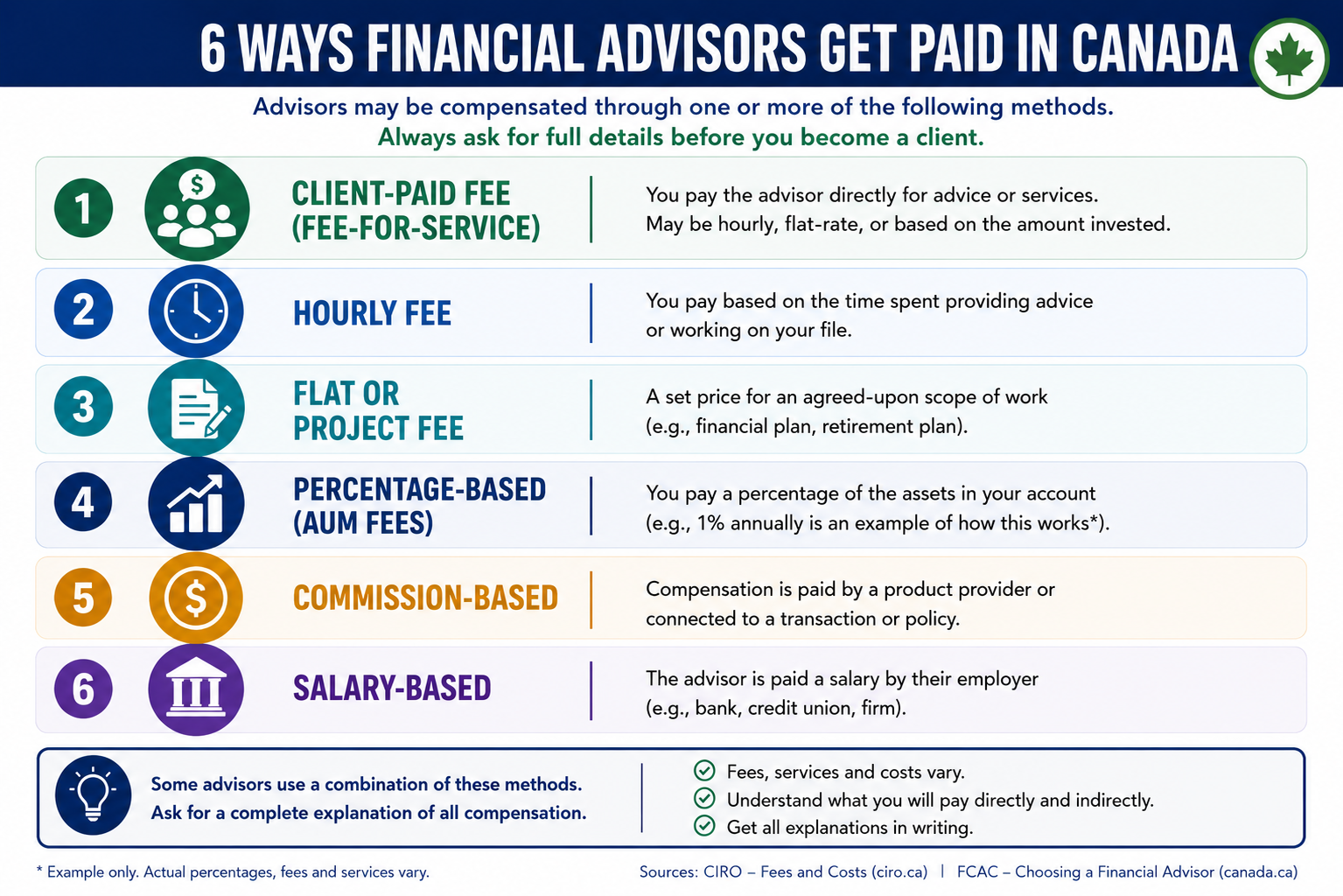
The Six Ways Financial Advisors Get Paid
There isn't one universal way financial advisors are compensated in Canada. Instead, advisors may charge clients directly, earn commissions from financial products, receive an annual percentage of the assets they manage, or use a combination of these methods.
Understanding each model will help you compare advisors on more than just performance. It will help you understand what you're paying for, how much you're likely to pay, and whether there are any potential conflicts of interest.
1. Fee-Only Financial Advisors
What is a fee-only financial advisor?
A fee-only financial advisor is compensated directly by the client. They do not receive commissions for recommending mutual funds, insurance policies or investment products.
Instead, their compensation typically comes from:
- Flat project fees
- Hourly fees
- Annual retainers
- Assets Under Management (AUM) fees (some fee-only firms)
Because they are paid directly by clients, fee-only advisors are generally viewed as having fewer financial incentives tied to recommending specific products. However, it's still important to ask exactly how they're compensated and whether they have any referral arrangements or other potential conflicts.
The Financial Consumer Agency of Canada recommends asking advisors how they're paid before agreeing to work together. (Source: FCAC)
Typical Cost in Canada
Pricing Model | Typical Range |
Hourly | $150–$500/hour |
Flat Financial Plan | $1,000–$5,000+ |
Annual Retainer | $2,000–$10,000+ |
AUM | 0.50%–2.00% annually |
Costs vary depending on the advisor's experience, your financial complexity and the services included.
Advantages
- Transparent pricing
- Advice isn't dependent on product sales
- Comprehensive planning focus
- Easy to understand what you're paying for
- Often ideal for DIY investors seeking planning advice
Disadvantages
- May require higher upfront payments
- Comprehensive plans can be expensive
- Investment implementation may require additional services
Best For
Fee-only financial advice is often a good fit for:
- Pre-retirees
- Business owners
- DIY investors
- Families wanting comprehensive financial planning
- Clients who prefer transparent pricing
2. Fee-Based Financial Advisors
Despite sounding similar, fee-based and fee-only are not the same thing.
A fee-based advisor charges fees to clients and may also receive commissions on certain investment or insurance products.
For example, an advisor may charge an annual planning fee while also receiving compensation when implementing insurance or investment recommendations.
This model offers flexibility, but it also makes it important to understand exactly how each recommendation is compensated.
Typical Cost
- Annual planning fee
- Percentage of assets managed
- Possible commissions on certain products
Advantages
- Comprehensive ongoing advice
- Broad range of investment solutions
- Can combine planning with implementation
- Suitable for long-term relationships
Potential Drawbacks
- Some recommendations may generate commissions
- Compensation can be more difficult to understand
- Clients should request a complete fee disclosure
Best For
Clients wanting:
- Ongoing planning
- Investment management
- Insurance advice
- One advisor coordinating everything
3. Commission-Based Financial Advisors
Commission-based advisors are paid when financial products are purchased or traded.
Compensation may come from:
- Mutual funds
- Segregated funds
- Insurance products
- Certain investment transactions
That does not automatically mean the advice is poor.
Many experienced advisors using this model provide excellent service and build long-term client relationships.
However, because compensation may depend on product sales, it's reasonable to ask whether alternative products or lower-cost solutions were considered.
Transparency is key.
Typical Costs
Rather than paying the advisor directly, compensation is often built into:
- Investment management fees
- Insurance premiums
- Product pricing
- Sales commissions (where applicable)
Depending on the product, these costs may be disclosed separately or embedded in the product's fee structure.
Advantages
- Often little or no upfront planning fee
- Easy access to investment products
- Suitable for investors starting out
- Long-established model
Disadvantages
- Potential conflicts of interest
- Costs may not always be obvious
- Product recommendations can vary between firms
Best For
- Investors purchasing insurance
- Clients wanting product implementation
- Individuals with straightforward investment needs
Earning a commission does not automatically make a recommendation unsuitable. However, commission-based compensation may create an incentive to recommend products that provide compensation to the advisor or firm. Ask what alternatives were considered, how much the advisor or firm receives and whether the recommended product carries embedded costs.
4. Assets Under Management (AUM)
Many Canadian wealth management firms charge a percentage of the assets they manage. Instead of paying a flat dollar amount, you pay an annual percentage based on your portfolio value.
Example:
Portfolio | 1.00% Annual Fee |
|---|---|
$250,000 | $2,500 |
$500,000 | $5,000 |
$1,000,000 | $10,000 |
$2,000,000 | $20,000 |
Many firms use tiered pricing, where the percentage decreases as assets increase.
Advantages
- Advisor is incentivized to help grow your portfolio
- Ongoing investment management
- Continuous financial planning
- Regular reviews
Considerations
As your portfolio grows, the dollar amount of the fee also increases.
For larger portfolios, it can be worthwhile comparing AUM pricing against flat-fee or retainer models to determine which offers the best value for your situation.
Best For
- Investors with larger portfolios
- Ongoing investment management
- Families wanting continuous financial planning
Under an assets-under-management arrangement, the client pays a fee calculated as a percentage of the assets in the account. CIRO gives 1% annually as an example of how this arrangement may work, but actual percentages and included services vary by firm.
5. Hourly Financial Advisors
Some advisors simply charge for their time. This model works much like hiring a lawyer or accountant. You book an appointment, receive advice, and pay only for the hours worked.
Typical Cost
Approximately $150–$500 per hour, depending on experience and specialization.
Advantages
- No ongoing commitment
- Transparent billing
- Great for second opinions
- Cost-effective for specific questions
Disadvantages
- Can become expensive if multiple meetings are required
- Limited ongoing support
- Investment implementation may not be included
Best For
- DIY investors
- People seeking a second opinion
- Individuals needing advice on a specific issue
CIRO describes fee-for-service arrangements as compensation based on an hourly rate, flat rate or a graduated rate related to the amount invested. The actual price and scope must be confirmed directly with the advisor.
6. Flat-Fee (Fee-for-Service) Financial Planning
Flat-fee planning has become increasingly popular in Canada.
Instead of paying based on your investments, you pay a fixed amount for a specific service.
Examples include:
- Retirement planning
- Tax planning
- Estate planning
- Cash flow planning
- Comprehensive financial plans
Whether your investment portfolio is $100,000 or $2 million, the price generally remains the same for the agreed-upon scope of work.
Typical Cost
Most comprehensive financial plans range from $1,000 to $5,000+, although more complex planning engagements may cost more.
Advantages
- Clear, upfront pricing
- No product sales required
- No ongoing obligation
- Easy to compare quotes between advisors
Disadvantages
- Does not typically include ongoing portfolio management
- Future updates may require a new engagement
- Implementation is often separate from planning
Best For
- Canadians wanting an unbiased financial plan
- Individuals approaching retirement
- DIY investors seeking professional guidance
- Families wanting a comprehensive financial roadmap
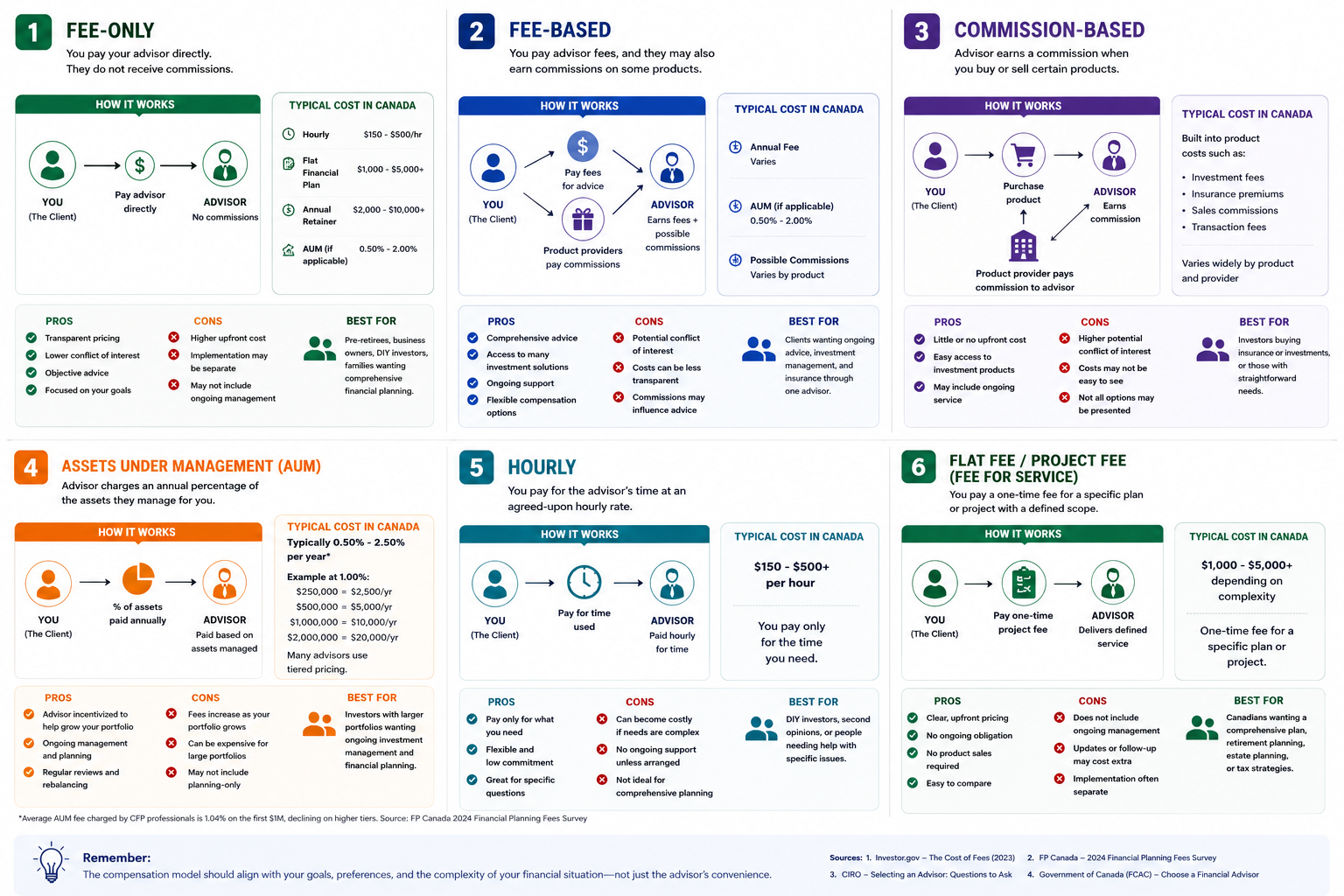
Transition
Now that you understand the six primary ways financial advisors get paid, the next question becomes more important:
Which compensation model is actually the best fit for your financial situation?
The answer depends on your goals, the complexity of your finances, whether you need ongoing investment management or simply a one-time financial plan, and how you prefer to pay for advice.
Which Financial Advisor Compensation Model Is Right For You?
There isn't a single "best" way for financial advisors to get paid.
The right compensation model depends on your financial situation, the complexity of your needs, and the type of relationship you want with your advisor.
For example, someone approaching retirement with a $1.5 million investment portfolio has very different needs than a young family looking for a one-time financial plan.
Instead of asking:
"Which compensation model is best?"
Ask:
"Which compensation model is best for me?"
The table below can help.
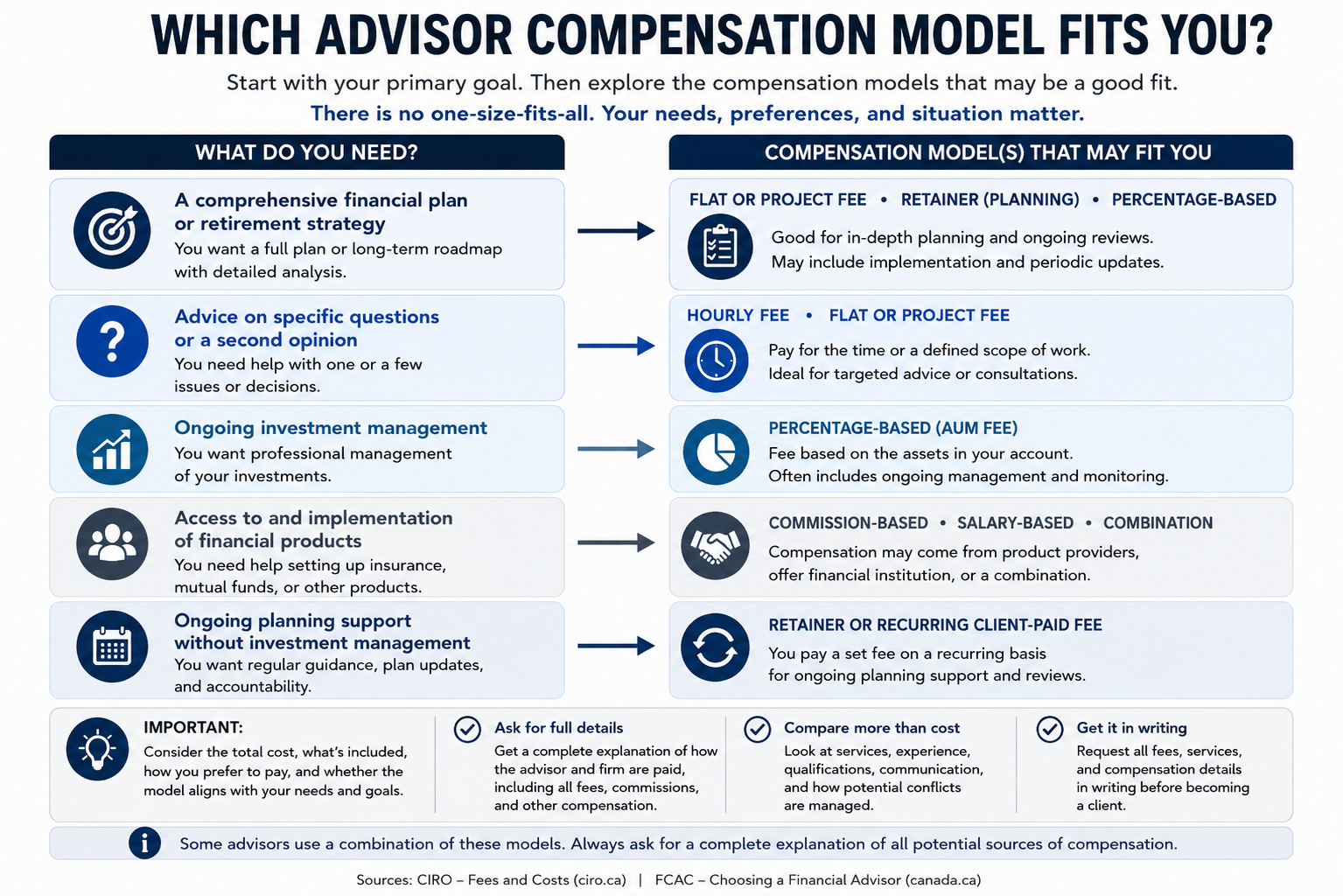
Decision Matrix
If you... | Consider |
Want an unbiased financial plan | Fee-Only |
Need a one-time retirement or financial plan | Flat Fee (Fee-for-Service) |
Want ongoing portfolio management | AUM |
Have one specific financial question | Hourly |
Want planning plus implementation from one advisor | Fee-Based |
Need insurance or investment products | Commission or Fee-Based |
Which Compensation Model Fits Your Situation?
Scenario 1
You're looking for a retirement plan.
You don't necessarily need someone managing your investments.
You simply want answers.
Examples:
- Can I retire at 60?
- Will I run out of money?
- Should I delay CPP?
- What's the best RRSP withdrawal strategy?
Best Fit: Flat Fee or Hourly
Scenario 2
You want someone managing everything.
You don't want to worry about investing.
You want:
- Investment management
- Retirement planning
- Tax planning
- Estate planning
- Ongoing meetings
Best Fit: AUM or Fee-Based
Scenario 3
You enjoy investing yourself.
You already buy ETFs.
You simply want professional advice every few years.
Best Fit: Fee-Only or Hourly
Scenario 4
You're approaching retirement.
Your questions become much more complicated.
Now you're thinking about:
- CPP timing
- OAS clawback
- Tax-efficient withdrawals
- Pension decisions
- Estate planning
Investment returns become only one part of the equation.
Best Fit: AUM or Fee-Only or Flat-Fee
depending on whether you also want investment management.
Scenario 5
You're just getting started.
You have:
- $40,000 invested
- A TFSA
- Maybe an RRSP
You don't need a complex retirement strategy.
You simply need someone to help you build a plan.
Best Fit: Fee-Based or Commission
Can make sense because there may be little or no upfront planning cost.
That said, it's still important to understand how your advisor is compensated and what fees you're paying.
Warning Signs
Compensation alone shouldn't determine whether you hire an advisor.
Instead, watch for warning signs like these.
- They won't clearly explain how they're paid.
- They avoid discussing fees.
- They can't explain why they're recommending a product.
- Everything they recommend pays them a commission.
- They discourage questions about costs.
- They can't explain the total cost you'll pay.
Transparency builds trust.
If an advisor can't clearly explain how they're compensated, that's worth exploring further before moving ahead.
Questions Every Canadian Should Ask a Financial Advisor
Bring these questions to your first meeting.
Compensation
- How do you get paid?
- Do you receive commissions?
- Do you receive referral fees?
- Are there any embedded fees?
- What will I pay each year?
Services
- What's included?
- How often will we meet?
- Do you provide tax planning?
- Estate planning?
- Retirement planning?
Investments
- Do you build portfolios?
- Which investments do you typically recommend?
- How often do you rebalance?
Experience
- Who are your typical clients?
- Do you specialize in retirement?
- Business owners?
- Young professionals?
Relationship
- Will I work with you directly?
- How often do we review my plan?
- What happens if my situation changes?
Callout Box
The best compensation model isn't necessarily the cheapest. It's the one that aligns with your goals, the complexity of your finances, and the value you receive.
A transparent advisor should be able to explain how they're paid, what you'll pay, and what services you'll receive before you become a client.
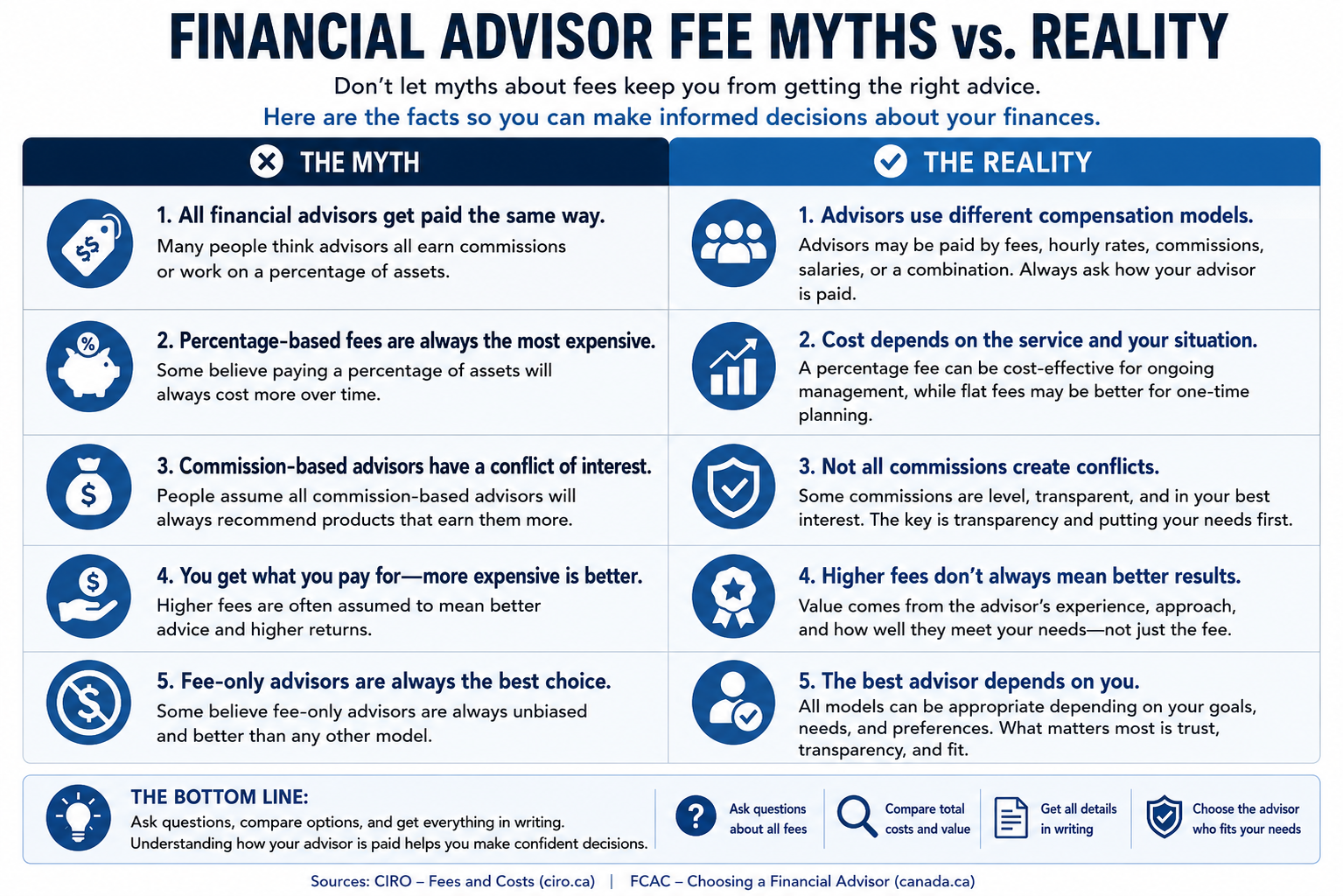
Common Myths About How Financial Advisors Get Paid
The way a financial advisor is compensated is often misunderstood. Terms like fee-only, fee-based and commission-based are frequently used interchangeably, even though they mean very different things.
Let's separate fact from fiction.
Myth #1: Fee-Only Advisors Are Always Better
Reality: Not necessarily.
Fee-only advisors generally have fewer financial incentives tied to recommending specific investment or insurance products because they're paid directly by clients.
However, compensation alone doesn't determine the quality of advice.
An experienced commission-based advisor who understands your goals and communicates transparently may provide better advice than an inexperienced fee-only planner.
Instead of focusing only on how an advisor is paid, consider:
- Their experience
- Credentials
- Areas of specialization
- Communication style
- Whether they act in your best interest
- The value they provide for the fees you pay
Bottom Line: Compensation is one factor, not the only factor.
Myth #2: Commission-Based Advisors Can't Be Trusted
Reality: That's an oversimplification.
Commission-based compensation has existed in Canada for decades and continues to be used by many advisors.
Many clients receive excellent long-term service under this model.
The important question isn't:
"Do they earn commissions?"
Instead ask:
"Why are you recommending this product, and what alternatives did you consider?"
A good advisor should have no problem explaining their recommendations and the costs involved.
Myth #3: Fee-Based and Fee-Only Mean the Same Thing
This is probably the most common misunderstanding.
Fee-Only
- Paid directly by clients
- Does not receive product commissions
Fee-Based
- Charges client fees
- May also receive commissions on certain products
Although the names sound similar, they describe different compensation models.
Always ask your advisor to explain exactly how they're paid.
Myth #4: More Expensive Advisors Are Better
Higher fees don't automatically mean higher-quality advice.
Likewise, the cheapest advisor isn't always the best value.
Instead of focusing solely on cost, consider:
- What's included?
- How often will you meet?
- Is tax planning included?
- Estate planning?
- Retirement projections?
- Investment management?
- Ongoing reviews?
A comprehensive financial plan that helps you avoid costly mistakes may provide far more value than a lower-cost option with limited services.
Myth #5: "Free" Financial Advice Is Actually Free
Many Canadians assume that if they aren't writing a cheque to their advisor, the advice must be free.
In reality, advisor compensation may be built into:
- Investment management fees
- Mutual fund MERs
- Insurance premiums
- Product costs
- Embedded commissions (where applicable)
That doesn't mean the advice lacks value, it simply means the compensation may be less visible.
Understanding the total cost of advice helps you compare advisors more effectively.
Myth #6: AUM Fees Always Cost More
Not always.
For someone with a modest investment portfolio who wants ongoing investment management, annual reviews, retirement planning and regular access to an advisor, an AUM fee may represent good value.
On the other hand, someone seeking a one-time retirement plan may spend less with a flat-fee planner.
The "best" pricing model depends on:
- Your assets
- The complexity of your finances
- The services you need
- How often you'll work with your advisor
Myth #7: Financial Planning and Investment Management Are the Same Thing
They're related, but they're not identical.
Financial Planning focuses on your overall financial life, including:
- Retirement planning
- Cash flow
- Tax planning
- Insurance
- Estate planning
- Education savings
- Goal setting
Investment Management focuses on selecting, monitoring and managing your investment portfolio.
Some advisors specialize in one, while others provide both.
Understanding which services you actually need can help you choose the most appropriate compensation model.
Expert Tip
Don't hire an advisor because they're fee-only, fee-based or commission-based. Hire them because they clearly explain how they're paid, demonstrate expertise, communicate openly, and provide services that match your financial goals.
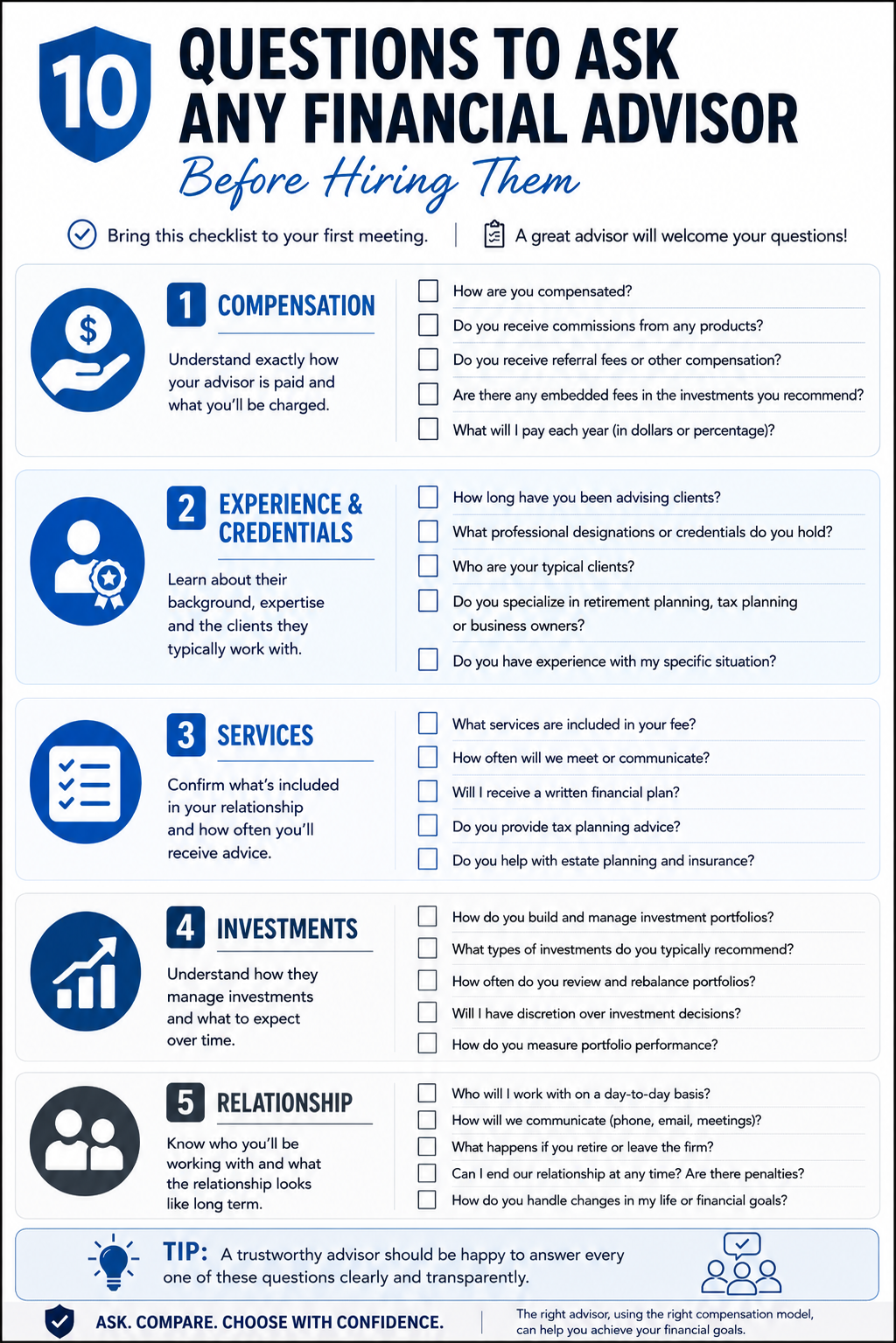
Questions to Ask Before Hiring a Financial Advisor
Bring this checklist to your first meeting.
Compensation
☐ How are you compensated?
☐ Do you receive commissions?
☐ Do you receive referral fees?
☐ Are there any embedded investment fees?
☐ What will I pay each year?
Credentials
☐ What professional designations do you hold?
☐ How long have you been advising clients?
☐ Who are your typical clients?
☐ Do you specialize in retirement planning, tax planning or business owners?
Services
☐ What's included in your fee?
☐ How often will we meet?
☐ Do you provide written financial plans?
☐ Will you review my investments?
☐ Do you help with taxes and estate planning?
Investments
☐ How do you build portfolios?
☐ What investments do you typically recommend?
☐ How often do you rebalance portfolios?
☐ Will I receive ongoing reviews?
Relationship
☐ Who will I work with?
☐ How will we communicate?
☐ What happens if my advisor retires or leaves the firm?
☐ Can I end the relationship at any time?
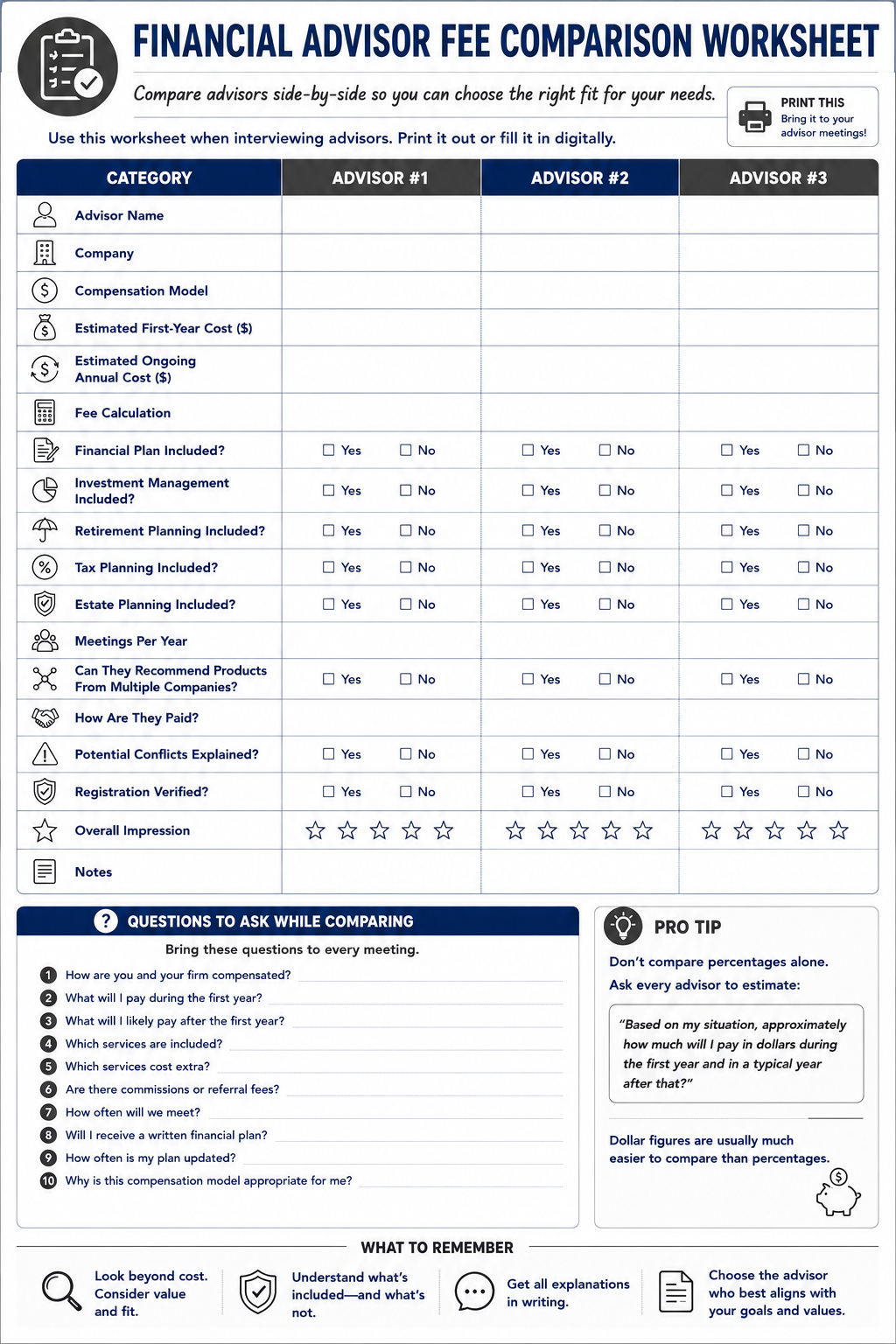
How to Compare Financial Advisor Fees
Finding the lowest fee isn't always the goal. Instead, compare what you're paying, what's included, and how the advisor is compensated.
Print this worksheet below or use it while interviewing advisors.
How to Compare Financial Advisors Beyond Their Fees
Understanding how a financial advisor gets paid is important, but it shouldn't be the only factor you consider.
A lower fee doesn't automatically mean better value, just as a higher fee doesn't automatically mean better advice.
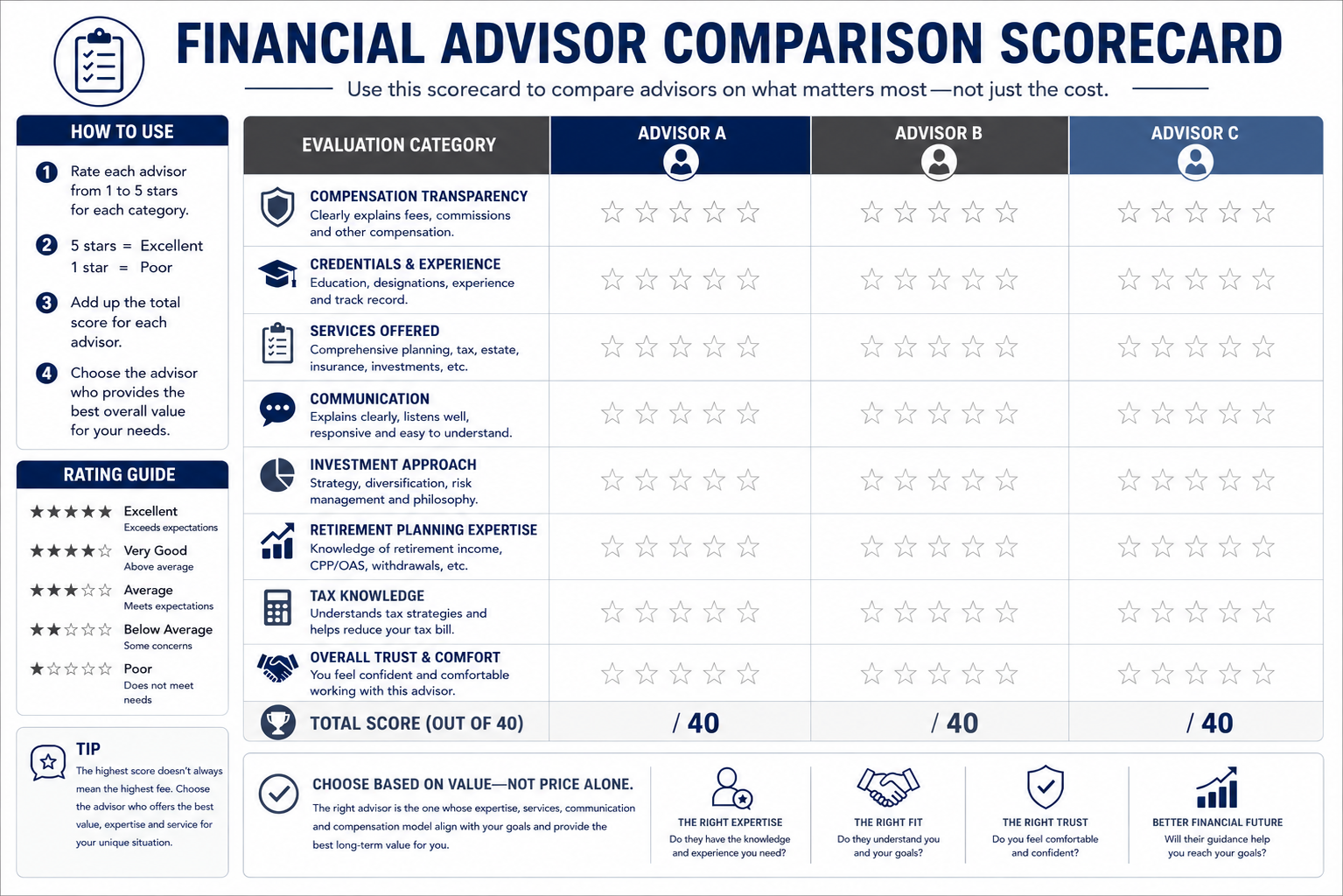
Instead, compare advisors using a combination of cost, expertise, services and overall fit.
1. Credentials & Qualifications
Start by asking about professional designations.
Some common Canadian credentials include:
Designation | Focus |
CFP® (Certified Financial Planner) | Comprehensive financial planning |
QAFP® (Qualified Associate Financial Planner™) | Foundational financial planning |
CFA® (Chartered Financial Analyst) | Investment management and portfolio analysis |
CIM® (Chartered Investment Manager) | Portfolio management |
A designation alone doesn't guarantee quality, but it does demonstrate education, examination requirements and continuing professional development.
2. Services Included
Two advisors may charge exactly the same fee while offering completely different services.
Ask whether their fee includes:
- Retirement planning
- Tax planning
- Estate planning
- Insurance analysis
- Cash flow planning
- Investment management
- Ongoing reviews
- Access between meetings
One advisor may simply manage investments.
Another may become your long-term financial partner.
3. Fiduciary Responsibility
Many Canadians search for a "fiduciary financial advisor."
While the term is important, it's also frequently misunderstood.
Rather than asking only:
"Are you a fiduciary?"
Also ask:
- Are you legally obligated to act in my best interest?
- How are potential conflicts managed?
- How are recommendations documented?
- Why are you recommending this strategy instead of another?
Transparency often tells you more than labels alone.
4. Communication Style
The best financial plan in the world isn't helpful if you don't understand it.
Ask yourself:
- Do they explain concepts clearly?
- Do they answer questions patiently?
- Do they educate instead of sell?
- Do they simplify complex topics?
You'll likely work with this advisor for many years.
Communication matters.
5. Fee Transparency
A trustworthy advisor should clearly explain:
- What you'll pay
- How they'll be paid
- What's included
- What isn't included
- Whether additional costs exist
If the fee structure feels confusing, ask questions until you're comfortable.
6. Technology & Client Experience
Today's advisors often provide:
- Client portals
- Digital document storage
- Online scheduling
- Virtual meetings
- Financial planning software
- Secure messaging
Convenience isn't everything, but it certainly improves the client experience. Print this scoreboard sheet below for your reference when comparing financial advisors.
Red Flags to Watch For
Most advisors are honest professionals who genuinely want to help their clients.
However, there are situations where you should slow down and ask more questions.
Watch for these warning signs:
- They can't clearly explain how they're compensated.
- They pressure you to make an immediate decision.
- They guarantee investment returns.
- They dismiss questions about fees.
- They recommend products before understanding your goals.
- They can't explain investment risks.
- They avoid providing written recommendations.
- They promise market-beating performance with certainty.
No advisor can predict the future or guarantee returns.
A trustworthy advisor will be upfront about both opportunities and risks.
Green Flags to Look For
Just as there are warning signs, there are also positive indicators.
Look for advisors who:
- Clearly explain how they're paid.
- Listen more than they talk.
- Ask thoughtful questions about your goals.
- Explain recommendations in plain language.
- Encourage questions.
- Provide written financial plans.
- Disclose all fees.
- Set realistic expectations.
- Focus on long-term planning rather than short-term performance.
Conclusion
Choosing a financial advisor isn't just about investment returns, it's about finding someone whose expertise, services and compensation model align with your financial goals.
Some Canadians benefit most from a fee-only planner who provides objective advice for a one-time financial plan. Others prefer an advisor who offers ongoing investment management through an assets-under-management (AUM) model.
Still others value the convenience of working with a fee-based or commission-based advisor who can provide both planning and product implementation.
There is no universal "best" compensation model.
The best choice depends on:
- Your financial goals
- The complexity of your finances
- Whether you want ongoing advice or a one-time plan
- How you prefer to pay for professional advice
The most important takeaway is simple:
Always understand how your advisor is compensated before you become a client.
A good advisor will explain their fees clearly, answer your questions openly and help you understand exactly what services you'll receive in return.
Ready to Find the Right Financial Advisor?
Whether you're looking for a fee-only financial planner, an advisor who offers ongoing wealth management, or simply a second opinion, we'll help match you with a professional whose compensation model and expertise fit your needs.
-> Complete our free advisor matching questionnaire to get started.
Frequently Asked Questions About Financial Advisor Fees
How do financial advisors get paid in Canada?
Financial advisors in Canada are typically compensated in one or more of the following ways:
- Fee-only
- Fee-based
- Commission
- Assets Under Management (AUM)
- Hourly fees
- Flat or project fees
The compensation model varies by advisor and firm. Before becoming a client, ask your advisor exactly how they are paid and request a clear explanation of all fees, commissions and any other compensation they receive.
What is the difference between fee-only and fee-based financial advisors?
A fee-only advisor is compensated directly by clients and generally does not receive commissions from financial products.
A fee-based advisor also charges client fees but may earn commissions from certain investments or insurance products.
Although the terms sound similar, they describe different compensation models.
Are commission-based financial advisors bad?
No.
Many commission-based advisors provide excellent financial advice and long-term service.
The important consideration isn't whether an advisor earns commissions—it's whether they're transparent about their compensation, explain their recommendations clearly and provide advice that's appropriate for your situation.
Is fee-only financial advice worth it?
For many Canadians, yes.
Fee-only advice can be particularly valuable if you're looking for:
- Comprehensive financial planning
- Retirement planning
- Tax planning
- Estate planning
- Objective recommendations
However, every situation is different. The best compensation model depends on your goals, the complexity of your finances and the services you need.
Do I pay financial advisor fees directly?
Sometimes.
Depending on the compensation model, you may:
- Pay directly by invoice
- Pay hourly
- Pay a flat planning fee
- Pay an annual percentage of assets under management (AUM)
In other cases, advisor compensation may be built into investment or insurance products.
Always ask for a full breakdown of the costs you'll pay.
How much does a financial advisor cost?
Costs vary significantly depending on the services provided.
Typical Canadian ranges include:
Service | Typical Cost |
Hourly Advice | $150–$500/hour |
Comprehensive Financial Plan | $1,000–$5,000+ |
Annual Retainer | $2,000–$10,000+ |
Assets Under Management | Approximately 0.50%–2.00% annually |
Fees may be higher for more complex financial situations.
Is a financial planner the same as a financial advisor?
Not always.
While the terms are often used interchangeably, financial planners generally focus on comprehensive financial planning, while financial advisors may provide investment management, insurance advice or both.
Some professionals provide both services.
Can I hire a financial planner for just one meeting?
Yes.
Many fee-only and hourly financial planners offer one-time consultations for topics such as:
- Retirement planning
- Tax planning
- Investment reviews
- Second opinions
- Cash flow planning
This can be an excellent option if you don't require ongoing portfolio management.
Which compensation model has the fewest conflicts of interest?
Many investors view fee-only compensation as having fewer potential conflicts because advisors are paid directly by clients rather than by product providers.
That said, no compensation model completely eliminates potential conflicts. Transparency, professionalism and acting in the client's best interest remain essential regardless of how an advisor is compensated.
Should I ask my financial advisor how they get paid?
Absolutely.
In fact, it should be one of the first questions you ask.
Understanding an advisor's compensation helps you:
- Compare advisors more effectively
- Understand the total cost of advice
- Identify potential conflicts of interest
- Choose a compensation model that aligns with your preferences
CIRO states that investors have a right to clear information about the fees and costs they pay and what those charges are for. Ask for the complete fee schedule and an estimate of the total annual cost in both dollars and percentages.
Sources
Canadian Investment Regulatory Organization (CIRO) on advisor compensation, fees and investor questions.
https://www.ciro.ca/office-investor/investing-basics/selecting-advisor
Financial Consumer Agency of Canada (FCAC) on how Canadians pay financial advisors and the importance of understanding compensation.
Reviewed by: FeeOnlyFinancial.ca Editorial Team